Flooded Basement Cleanup in Mud Creek: Drying & Cost
When your basement floods in Mud Creek, the first hour decides what gets saved and what gets thrown in a dumpster next week. Water spreads fast across a concrete slab, wicks up drywall, soaks into carpet pad, and migrates into wall cavities where you cannot see it. By the time most homeowners call us at Mud Creek Water Restoration, the visible water is only a fraction of the actual problem. The real damage is sitting inside the framing, behind the baseboards, and under the flooring, where moisture meters and thermal imaging are the only honest witnesses.
This guide is built around one detailed comparison that most Mud Creek homeowners never get to see before they sign a contract. We are going to lay out the realistic scenarios, the IICRC water categories, the drying timelines, and the cost ranges side by side so you can make a clear decision while the pumps are still running. If you are reading this in a panic at midnight with a wet shop vac in your hand, skip to the table, then come back for the context. If we cannot help you, we will tell you directly and point you to someone who can.
Problem: You Cannot Tell How Bad the Water Damage Actually Is
Standing water is only part of the story. The bigger issue is what you cannot see. Water wicks up drywall at roughly one inch per hour, slides under baseboards, and saturates the bottom plate of every framed wall it touches. A basement that looks like a half inch of nuisance water can hide 200 to 400 gallons absorbed into materials. Without moisture readings, you are guessing, and guessing is how mold colonies start in week two.
Solution: Commercial Air Movers and LGR Dehumidifiers, Sized to the Space
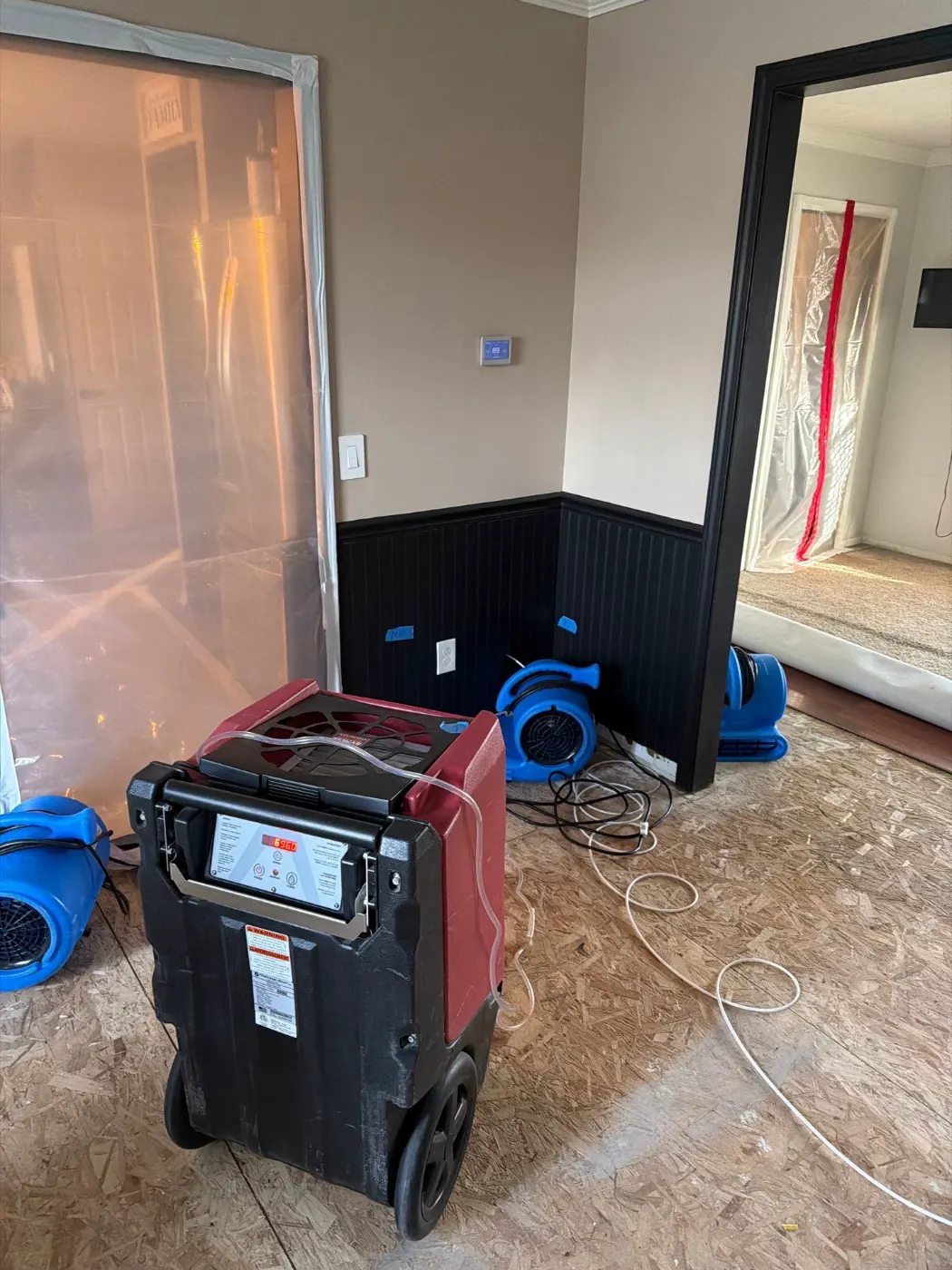
Professional drying uses three pieces of equipment working together:
- Low grain refrigerant (LGR) dehumidifiers that remove 15 to 30 gallons of moisture per day each, depending on size.
- Air movers placed every 10 to 16 linear feet along wet walls to break the boundary layer of saturated air.
- HEPA air scrubbers when contamination or mold spores are present.
A typical Mud Creek basement of 800 to 1,200 square feet needs 4 to 8 air movers and 1 to 2 commercial dehumidifiers running 3 to 5 days, with daily moisture readings to confirm progress. In tighter spaces or finished basements with multiple rooms, we may also drill small ventilation holes behind baseboards to push dry air into wall cavities without tearing out drywall that is still structurally sound.
Problem: The Water Keeps Coming Back After You Pump It Out
Homeowners often shop vac the visible water, run a box fan overnight, and wake up to fresh puddles. That happens because the source was never controlled. Common culprits in Mud Creek basements include failed sump pumps during heavy rain, sewer line backups, foundation cracks under hydrostatic pressure, and burst supply lines on the floor above. We also see clogged floor drains, frozen pipe bursts in unheated utility rooms, and water heater tank failures that quietly leak hundreds of gallons before anyone notices.
When to Call and What to Expect Next
If water is actively rising, shut off power to the affected area at the breaker, stay out of standing water near outlets, and call for help. Mud Creek Water Restoration runs 24 7 emergency response across Mud Creek and Central Indiana, typically arriving within 2 hours. We give you a clear scope, honest pricing, and direct communication with your adjuster. If your situation does not need full restoration, we will tell you that too. Reach out anytime, and we will walk you through the next step.
Solution: Identify and Stop the Source Before Drying Starts
Drying a basement while water is still entering is wasted money. Our crew traces the source first. If it is a sump failure, we stage a backup pump. If it is a sewer backup, the job shifts to a different protocol entirely, which you can read about on our sewage cleanup service page. If the source is groundwater through a foundation crack, we coordinate with a waterproofing specialist before final drying. Stopping the inflow can save you 1,500 to 4,000 dollars in repeat extraction costs. We also recommend a quick check of your gutter discharge and grading around the foundation, because a downspout dumping water two feet from the wall is often the hidden reason a Mud Creek basement floods every spring.
Problem: You Are Not Sure What to Do in the First Hour
Most homeowners freeze when they see a flooded basement, and the wrong first move can make insurance harder or put you in physical danger.
Problem: Fans From the Hardware Store Are Not Drying Anything
Two box fans and a residential dehumidifier cannot pull the moisture load out of a flooded basement. Concrete holds water for weeks. Wood framing dries from the outside in, and without controlled airflow plus dehumidification at the right grain depression, you trap moisture behind walls. That is the recipe for the musty smell that shows up three weeks later. Residential units also lack the amp draw and condensate capacity needed for a saturated space, and they often raise the temperature without lowering the humidity, which actually slows evaporation.
Solution: Verify Dry Standards Before Equipment Comes Out
We do not pull equipment because the floor feels dry. We pull it when moisture content in wood reaches 15 percent or below and drywall matches the dry standard set by an unaffected area. Final readings get logged and shared with you. If anything is borderline, equipment stays another day at no surprise charge.
Solution: Get a Professional Moisture Map in the First Few Hours
A proper assessment uses penetrating moisture meters, thermal imaging, and hygrometers to map exactly which materials are wet and how deep the saturation runs. When Mud Creek Water Restoration responds to a Mud Creek call, our technician documents readings room by room, photographs everything for your insurance file, and assigns an IICRC water category (Cat 1 clean, Cat 2 gray, Cat 3 black). That category drives every decision afterward, including whether carpet pad can dry in place or must be removed. For a deeper walk through of the assessment process, see our guide on basement flooding cleanup steps.
Problem: You Are Worried About Mold Showing Up Later
Mold needs moisture, organic material, and 48 to 72 hours. A basement that sits wet for a weekend is already on the clock. Even after the visible water is gone, trapped moisture behind drywall or under flooring keeps feeding spores for weeks. Finished basements are especially vulnerable because paper faced drywall, carpet pad, and engineered flooring all act like sponges that hold moisture against framing long after the surface looks normal.
Problem: You Have No Idea What This Is Going to Cost
Pricing fear keeps people from calling, and that delay almost always makes the job bigger. The honest answer is that flooded basement cleanup in Mud Creek typically runs between 2,500 and 8,000 dollars for Cat 1 or Cat 2 losses, and 7,000 to 25,000 dollars when sewage, finished walls, or extensive flooring are involved.
Solution: Follow a Short Safety Checklist Before Anyone Steps In
Shut off power to the basement at the breaker if you can do it safely from a dry location. Do not wade into standing water near outlets, panels, or submerged appliances. Photograph everything before moving items. Then call Mud Creek Water Restoration so a technician is dispatched while you start moving dry contents off the floor upstairs.
Solution: Understand What Drives the Price, and What Insurance Covers
The main cost drivers are:
- Water category (clean water is cheapest, sewage is the most expensive due to PPE, disposal, and antimicrobial work).
- Square footage affected and how many materials need removal versus drying in place.
- Equipment days on site, billed per piece per day.
- Reconstruction scope after drying, including drywall, baseboard, flooring, and paint.
Most homeowner policies cover sudden and accidental water damage, like a burst pipe or appliance failure, but exclude groundwater and sewer backup unless you carry specific endorsements. We document everything to the standard adjusters expect. For a full price breakdown, our water damage restoration cost guide walks through line items in detail.
Frequently Asked Questions
How fast does Mud Creek Water Restoration arrive in Mud Creek for a flooded basement?
Our standard target response is 60 to 90 minutes within the Mud Creek service area, 24 hours a day. Severe weather events may extend that window, and we communicate ETA updates by text.
How long does professional drying take?
A typical Mud Creek basement dries in 3 to 5 days when equipment is sized correctly. Class 3 and Class 4 losses with saturated concrete or hardwood can extend to 7 to 10 days. We verify with moisture meters before removing equipment.
Will my homeowners insurance cover the cleanup?
Sudden internal failures like burst pipes are usually covered. Groundwater intrusion and surface flooding require flood insurance. Mud Creek Water Restoration documents the loss to IICRC S500 standards so your adjuster has what they need.
Can I just rent fans and dry it myself?
For under 50 square feet of clean water caught within an hour, sometimes yes. Anything larger, anything older than 24 hours, or any Category 2 or 3 water requires commercial dehumidifiers and antimicrobial treatment to prevent mold.
What if the water is sewage?
Do not enter the area. Category 3 water carries pathogens and requires PPE, containment, and regulated disposal. Call Mud Creek Water Restoration and we dispatch a sewage-certified crew with the correct equipment immediately.
Have a restoration question?
Our IICRC certified Mud Creek crew is ready to help. Free assessments, estimate based on what we can sees, no pressure.